Article · about 6 minutes
How tides work
Why the sea rises and falls about twice a day, why some tides are bigger than others, and how tide tables are worked out years ahead.
The pull of the Moon
Tides are the regular rise and fall of sea level. They are caused mainly by the Moon's gravity, with a smaller share from the Sun.
What matters is not the strength of the Moon's pull but how much it changes across the Earth. The side of the Earth facing the Moon is about 12,700 km closer to it than the far side, so it is pulled a little harder. This difference in pull is called the tidal force. It stretches the oceans along the line between the Earth and the Moon.
The Sun is far more massive than the Moon, but it is also about 390 times farther away. Tidal force falls off with the cube of distance, so the Sun's tidal effect on Earth is a bit less than half of the Moon's.
Why there are two tides a day
The stretching makes two bulges of water: one on the side facing the Moon and one on the opposite side. The Earth turns underneath both of them, so most coasts pass through two high tides and two low tides each day.
The Moon moves along its orbit in the same direction the Earth spins, so it takes the Earth a little longer than a day to catch up with it. A lunar day is about 24 hours and 50 minutes. That is why high tide comes about 50 minutes later each day, and why two high tides are usually about 12 hours and 25 minutes apart.
Spring and neap tides
Twice a month, at new moon and full moon, the Sun, Earth and Moon line up. The Sun's tidal force adds to the Moon's, and the difference between high and low water is largest. These are spring tides. The name has nothing to do with the season; it comes from the water seeming to spring up.
At the first and last quarter moon, the Sun and Moon are at right angles as seen from Earth. Their tidal forces partly cancel, and the range is smallest. These are neap tides.
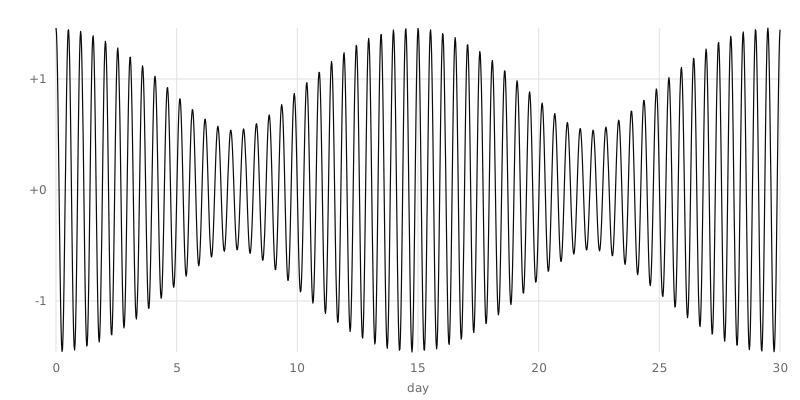
The Moon's orbit is also not a perfect circle. When a spring tide falls close to the Moon's nearest point to Earth, the range is a little larger again. These are sometimes called perigean spring tides or king tides.
Daily patterns around the world
The two-bulge picture is a simplification. Real oceans are shaped by coastlines, sea floor depth and the size of each basin, so the water does not simply follow the Moon. Coasts fall into three broad patterns:
- Semidiurnal: two high and two low tides of about the same height each day. Common on the Atlantic coasts of Europe and North America.
- Mixed: two high and two low tides of clearly different heights. Common on the Pacific coast of North America.
- Diurnal: one high and one low tide each day. Found in parts of the Gulf of Mexico and Southeast Asia.
The size of the tide varies just as much. The Bay of Fundy in Canada has the largest tidal range in the world, up to about 16 metres, because the shape of the bay makes the water slosh in step with the tide. Enclosed seas such as the Mediterranean have tides of only a few tens of centimetres.
The highest high tide of the day is not always when the Moon is overhead. In many places it comes hours later, because the water takes time to move around the basin.
How tides are predicted
Tide tables are not worked out from the Moon's position directly. Instead, sea level is recorded at a tide gauge for a year or more, and the record is split into a set of regular waves called harmonic constituents. Each one has a fixed period set by astronomy. Only its height and timing at that place have to be measured.
| Name | Description | Period (hours) |
|---|---|---|
M2 | Principal lunar, twice daily | 12.42 |
S2 | Principal solar, twice daily | 12.00 |
N2 | Larger lunar elliptic, twice daily | 12.66 |
K1 | Lunisolar, once daily | 23.93 |
O1 | Principal lunar, once daily | 25.82 |
Once the constituents for a place are known, a prediction is just their sum. A simple version in JavaScript:
// Each constituent: amplitude (m), period (h), phase (radians).
function tideHeight(hours, constituents, meanLevel = 0) {
  return constituents.reduce((h, c) =>
    h + c.amp * Math.cos((2 * Math.PI * hours) / c.period - c.phase), meanLevel);
}

const example = [
  { name: "M2", amp: 1.0,  period: 12.42, phase: 0 },
  { name: "S2", amp: 0.46, period: 12.00, phase: 0 },
];
tideHeight(6, example); // height 6 hours from the start
Real predictions use dozens of constituents and add a mean sea level for the site. Weather can still push the actual level well above or below the prediction: strong onshore winds and low air pressure raise it, which is how storm surges happen.
Tides and the length of the day
As the oceans move, they rub against the sea floor and lose energy. This tidal friction slowly brakes the Earth's spin, making the day longer by around 2 milliseconds per century. The same interaction transfers momentum to the Moon, which moves about 3.8 centimetres farther from Earth each year. This is measured by bouncing lasers off reflectors left on the Moon by the Apollo missions.
This article is general background written for this sample site. Figures are rounded. Back to top